Explainer
Backtesting vs forward testing vs replay
A backtest runs your rules over past data, a forward test runs them on new data as it comes, and a replay lets you step through history one bar at a time.
Updated
Three tools, three questions
A backtest asks what these exact rules would have done over past data. A forward test asks how the rules behave on prices that have not happened yet. A replay asks how a setup looks, and how you handle it, as the chart unfolds bar by bar.
They answer different questions, so they do not compete.
- Backtest
- Exact rules run over past data, all at once.
- Forward test
- The same rules run on prices as they arrive, with no real order placed.
- Replay
- Past data shown one bar at a time, with later bars hidden.
- Paper trading
- Placing orders against a simulated account instead of a real one.
Backtest
A backtest needs rules that cannot be misread, because a computer follows them literally. In return you get years of trades in minutes, with a trade count and a full record of every entry and exit.
Its limit is that the rules were written with the history in view. It also models its fills. In ours, a target fills on touch at the exact price. A stop fills at the stop price plus slippage, or at the bar’s own open if price gapped through it. Costs are applied after the run and do not move fills.
Forward test
A forward test runs the rules on live prices as they arrive, on paper. You cannot look ahead, because the bars do not exist yet. That is what makes it different from everything done on history.
The price of that is time. You only get trades as the market produces them, so a rule that trades rarely takes a long time to build a sample. Fills on paper are still modelled, not real.
Replay
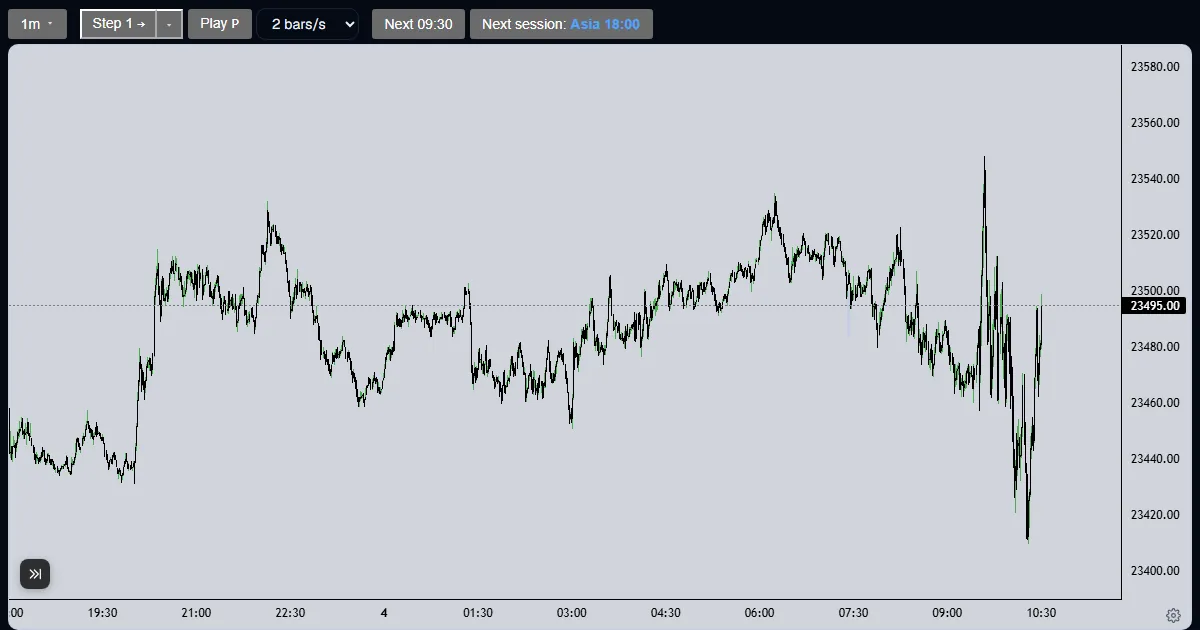
A replay shows past data one bar at a time. In our Trade Lab you pick NQ, ES or GC and a start date, then step forward through 1-minute bars. No bar after the current one is loaded, and a replay cannot be moved backward.
You can draw on the chart, keep a journal of each decision and place paper orders. Paper fills are evaluated on 1-minute bars, so they approximate live fills. It uses history only: there is no live data, and no real order is ever placed. It is free with an account and a verified email.
A replay is how you test a setup by hand. Use it when your rules are not yet exact enough for a computer.
When to use each
Start from the question you have:
- Your rules are fuzzy: replay a few days and find out what you really do, then write the rules down.
- Your rules are exact and you want a count of trades: backtest them.
- A backtest result looks interesting: forward test the rules on new data before you lean on it.
A backtest tells you what the rules did. Only new data tells you what they do next.
Using them together
The three fit in a loop. Replay to find the setup. Backtest to count it, with months held back. Forward test what is left on prices that have not happened yet.
Each step removes a way of fooling yourself that the one before it left open.
Questions and answers
Is a replay the same as a backtest?
No. A backtest runs fixed rules over the history at once. A replay shows the history one bar at a time and you make each decision yourself. A replay can feel like a manual backtest, but you decide as you go and the sample is only as large as the days you step through.
Is forward testing the same as paper trading?
A forward test is usually done on paper, so the two overlap. The point of a forward test is that the data is new. Paper trading on history, as in a replay, is not a forward test.
Does the replay show bars from the future?
No. The server never sends a bar later than the current one.
How long should a forward test run?
It depends on how often the rules trade. A rule that trades daily builds a sample far faster than one that trades a few times a year. See how many trades a backtest needs.