Explainer
How do I practise for a prop-firm evaluation with replay?
Set a paper account of the evaluation’s size in micros, write your risk rules first, trade a session by them and journal whether you kept them.
Updated
The short answer
Evaluations are mostly about following a rule set under pressure. A replay can rehearse the habits: a fixed size, a stop on every trade, a limit on losses. It cannot rehearse a firm’s own rules for you, because the Trade Lab applies none of them.
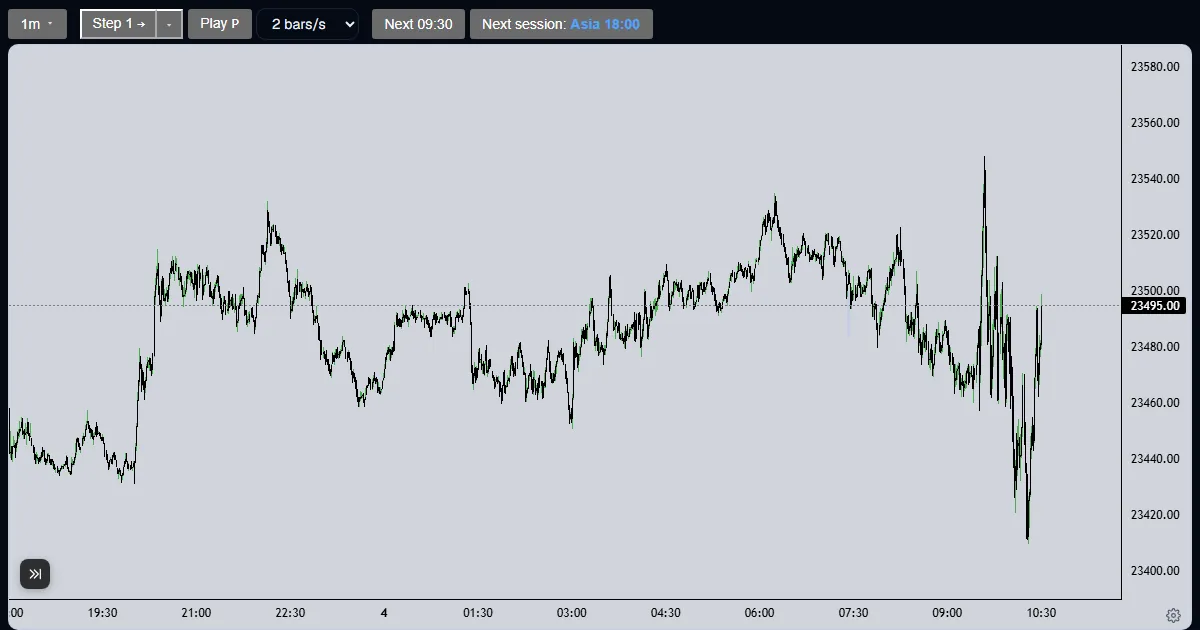
This walkthrough uses NQ on Wednesday 2025-06-11 (contract NQM5) with a $50,000 paper account in MNQ. Read the rules of the programme you plan to join, then write the ones that matter into your journal. Our explainers on trailing drawdown and the daily loss limit cover how such rules are usually built.
- Evaluation
- A paid test of a trading account against a rule set, with a drawdown limit and often a daily loss limit.
- Micro contract
- A contract with a fraction of the full size. MNQ is $2 a point; NQ is $20 a point.
Rehearse the habits
Match the account
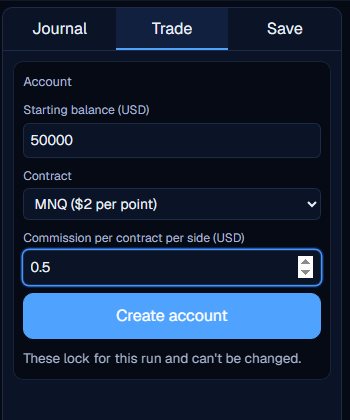
Open a replay and make the paper account once: a $50,000 starting balance, the MNQ contract and a commission per side. These lock for the run, so choose them as you would for the real account.
Write the rules first
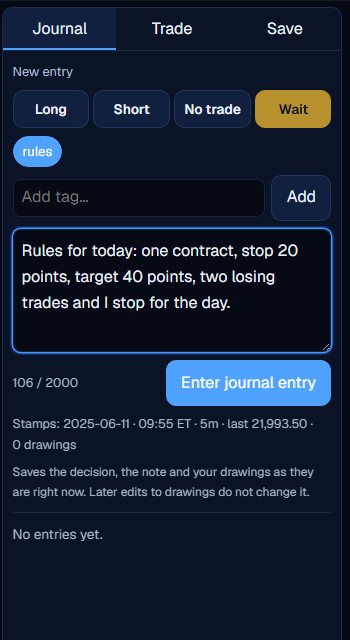
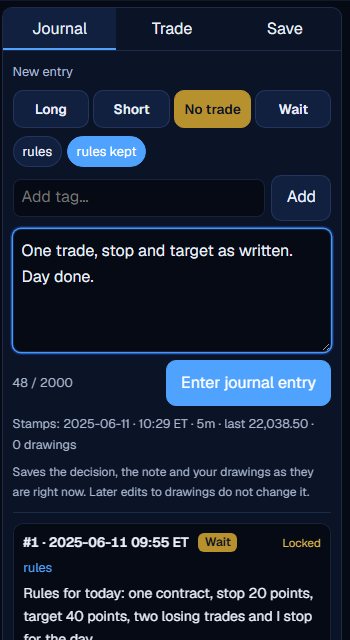
In the Journal, write today’s rules before the first trade: here one contract, a 20-point stop, a 40-point target and a stop for the day after two losing trades. Tag it rules and enter it.
Trade by the rules
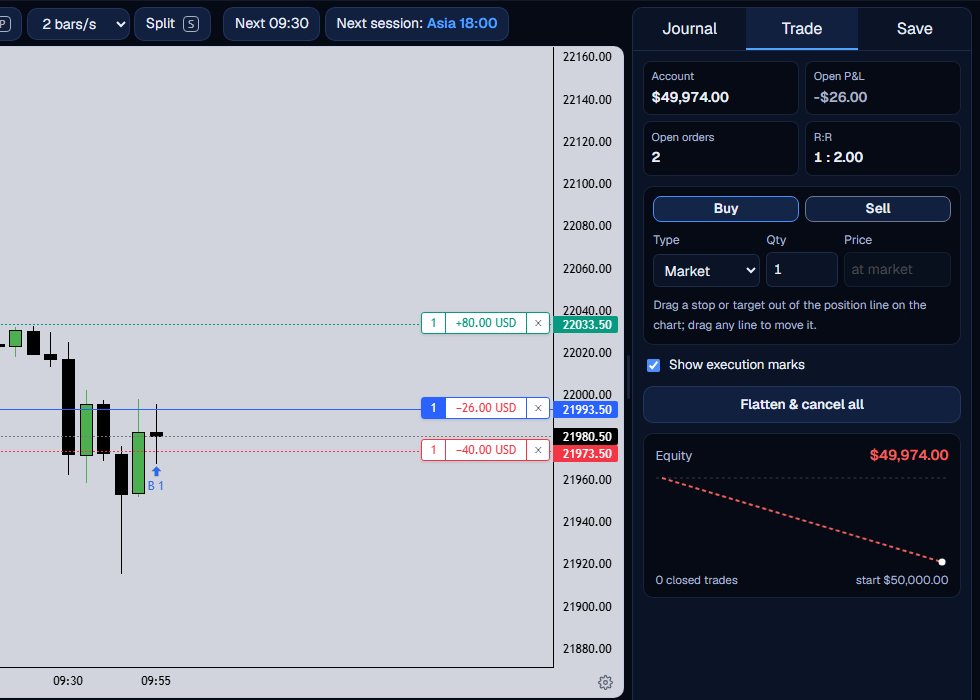
Place the order and drag the stop 20 points under the entry and the target 40 points above it. The R:R tile reads 1 : 2.00, which confirms the sizes.
Journal whether you kept them
When the trade closes, choose No trade for the rest of the session, add the tag rules kept or rules broken, and write the truth. Honest tags are what make the log useful.
What a replay cannot show
The Lab has no drawdown limit, no daily loss limit and no consistency rule. Your paper balance simply moves. You track the limits yourself, with the numbers from your own programme, or you note in the journal when a limit would have been hit.
It also cannot copy the pressure of a funded account. What it can do is make the routine automatic: size, stop, target, stop for the day. Many people repeat the same session type on many different dates until the routine is boring.
Read each programme’s own rules before you pay for it. They differ, and they change.
A replay trains your habits, not the firm’s rules: write your own limits into the journal and keep to them.
What the Trade Lab does not do
The Trade Lab replays history. It has no live data, and no real order is ever placed. Paper fills are modelled on 1-minute bars, so they approximate real fills.
Each account can read 40 distinct 1-minute sessions and start 5 new runs per UTC day, and it needs a verified email. The Lab itself is free.
Questions and answers
Can I practise for a prop firm evaluation on a replay?
You can rehearse the habits: fixed size, stops, a daily limit. The Trade Lab does not apply any firm’s rules, so you track them yourself.
Does the Lab track a trailing drawdown?
No. It shows equity and a maximum drawdown figure for closed trades, but it does not enforce any limit.
Which contract should I use for a $50,000 paper account?
That depends on your risk rules. The Lab offers MNQ at $2 a point and NQ at $20 a point on an NQ run, and the account locks for the run.
Is the paper account the same as a funded account?
No. Orders fill on 1-minute bars, there is no live data and no real order is placed.
How many sessions can I practise a day?
Each account can read 40 distinct 1-minute sessions and start 5 new runs per UTC day.