Explainer
How do I practise an opening-range strategy bar by bar?
Step to the end of the first 15 minutes, box the range, step candle by candle until one closes outside it, journal the call and paper trade it.
Updated
The short answer
An opening range is the high and low of the first minutes after 09:30 Eastern. An opening-range strategy waits for price to leave that box. Practising it bar by bar means building the box from real candles and then deciding one candle at a time, with nothing later on the chart.
This walkthrough uses NQ on Thursday 2025-06-12 (contract NQM5), a 15-minute range and one written rule: enter at the first 5-minute close outside it. The rule is for practice. It is not a claim about any result.
- Opening range
- The high and low of a fixed window after the open. This guide uses the first 15 minutes, three 5-minute candles.
- Breakout candle
- The first candle that closes above the range high or below the range low.
From the range to a paper trade
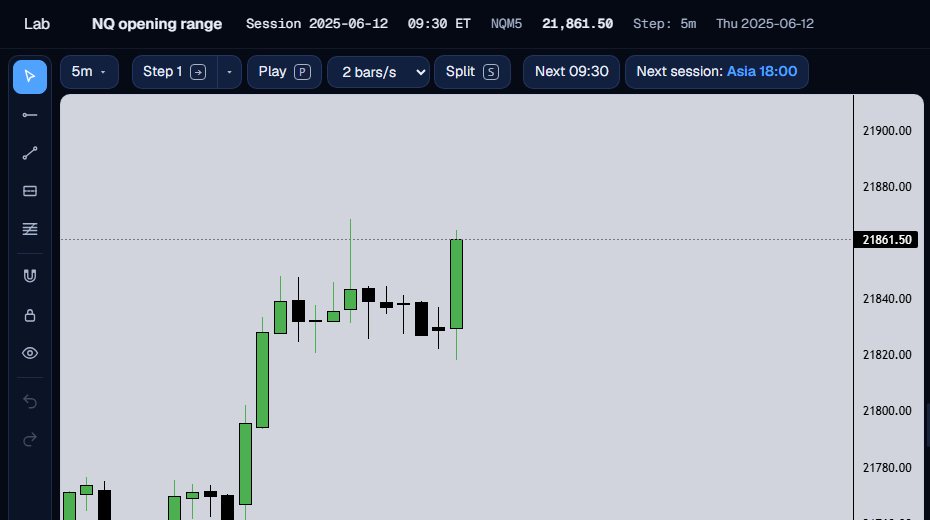
Start at 09:30
Open an NQ replay on 2025-06-12 and jump to the 09:30 bar. Keep the timeframe on 5 minutes.
Let the range form
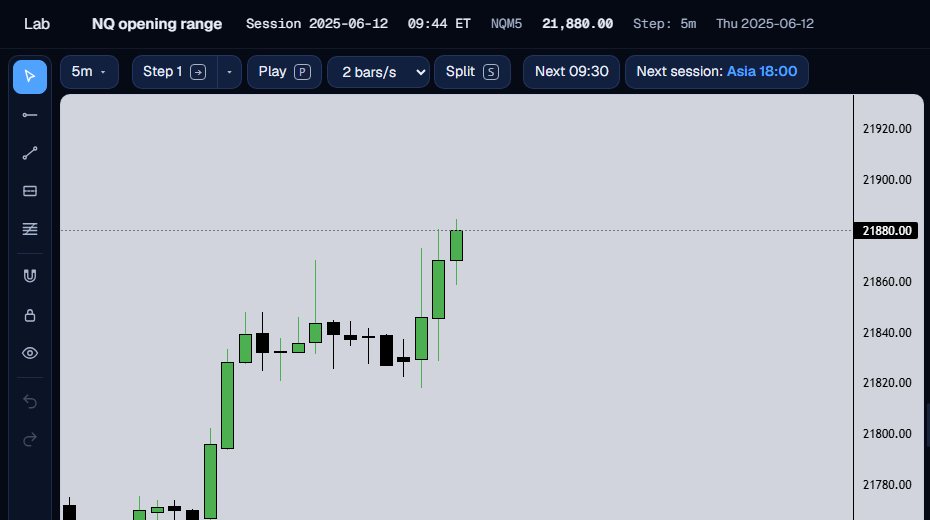
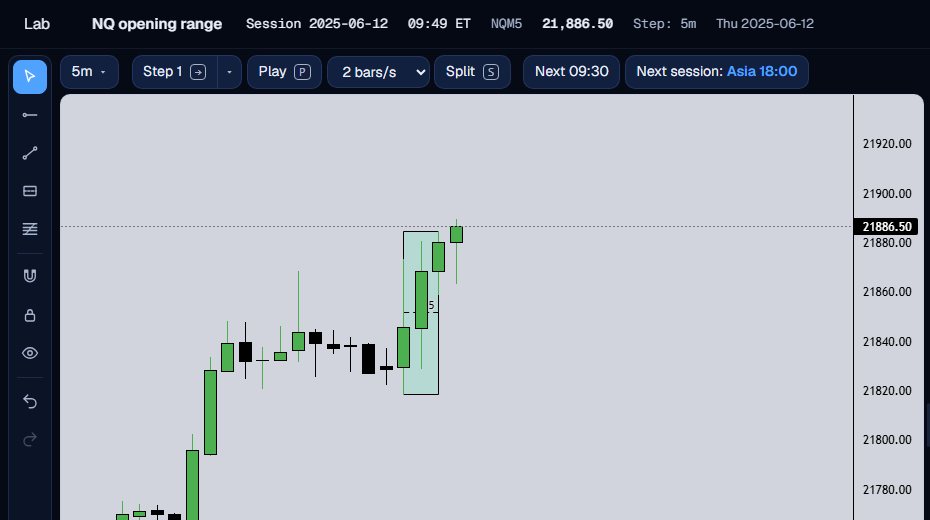
Press Step until the clock reads 09:44. The 09:30, 09:35 and 09:40 candles are complete, which is the 15-minute range.
Box the range
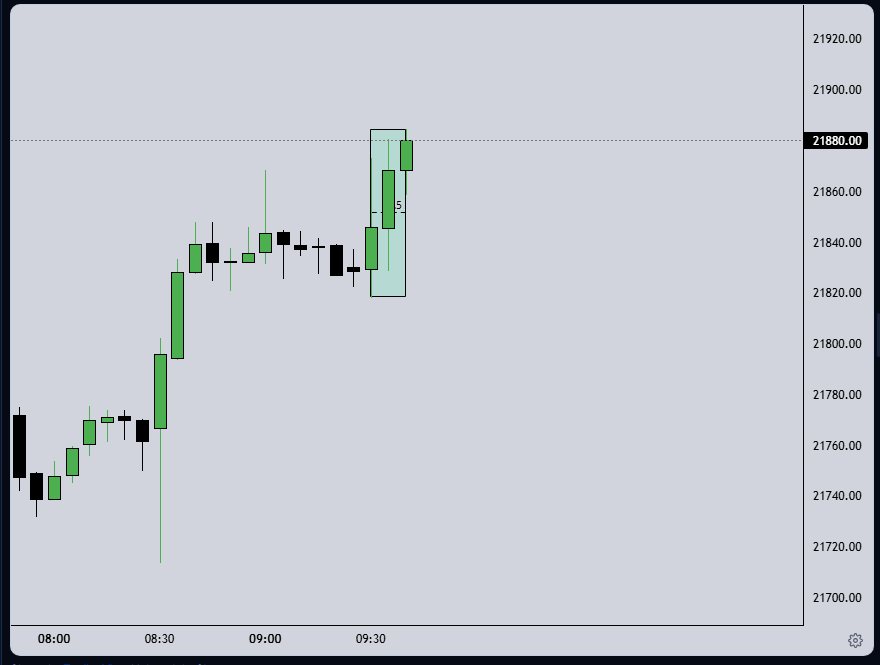
Pick the box tool and draw it across the three candles, from the range high 21,884.50 down to the range low 21,818.50.
Step until a candle closes outside
Press Step one candle at a time. The 09:45 candle closes at 21,886.50, above the range high, so under the written rule this is the entry candle.
Journal the call
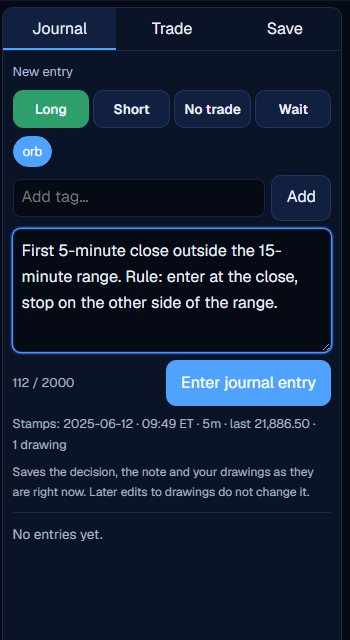
Choose Long, tag it orb and write the rule you applied: first 5-minute close outside the range, stop on the other side. Enter the entry before placing anything.
Place the paper trade
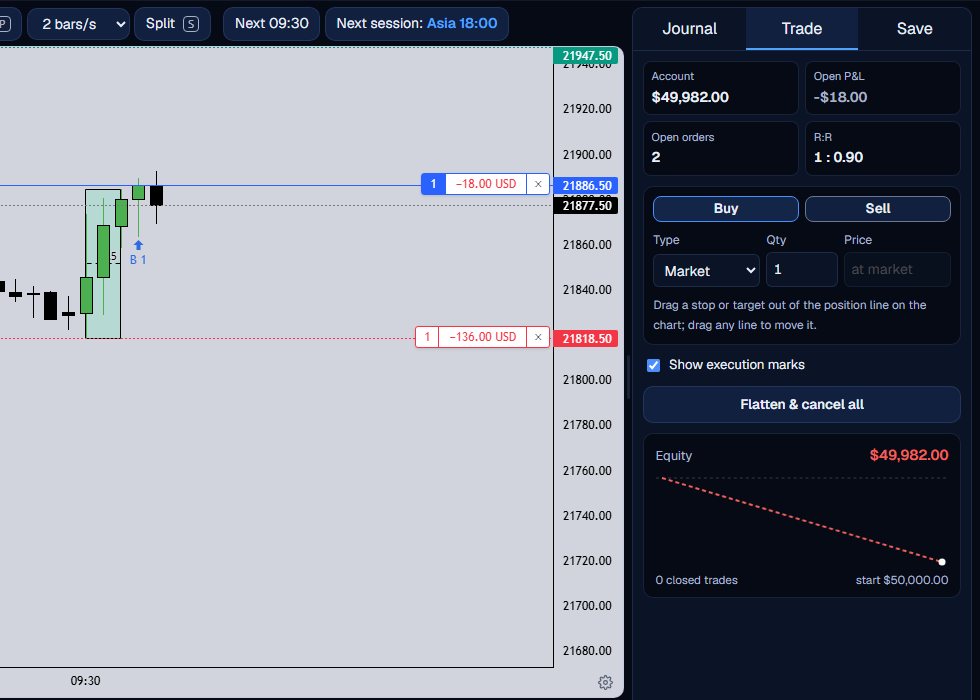
Create the paper account once (here MNQ, a $50,000 balance and $0.50 commission per side), press Buy, then drag the stop out to the range low, 21,818.50, and the target up above the entry, here to 21,947.50.
Step until it closes
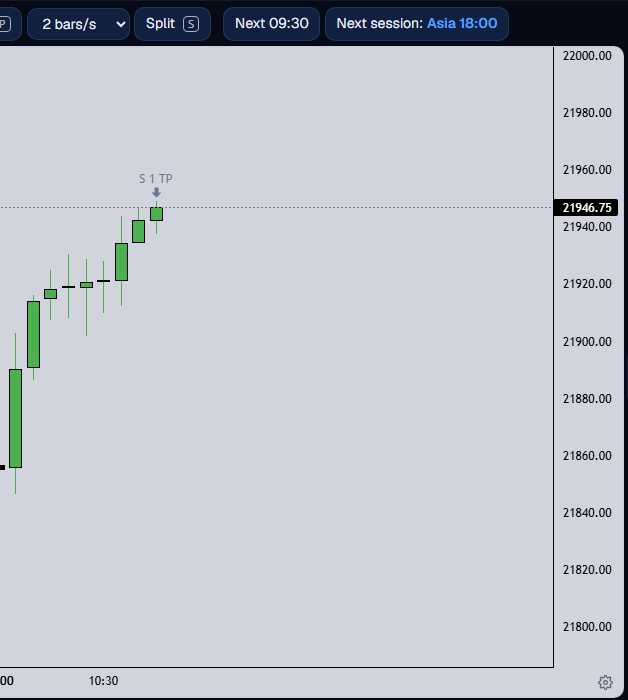
Keep stepping. The Lab fills the stop or the target on the 1-minute bars. In this session the target was reached later in the morning; that is one trade on one day and says nothing about the rule.
Make the rule yours
Everything in the walkthrough is a choice you can change: a 5-minute, 15-minute or 30-minute range, a close or a touch as the trigger, a stop at the other side or at the middle, a target of one range or more. Write the version before you start, so the replay tests your discipline and not your memory.
A gap through an order fills at the open, and if a stop and a target are touched in one bar the stop fills, so a replay is stricter than a drawing on a chart.
Write the rule first, then step. A rule you adjust after seeing the next candle is not being practised.
What the Trade Lab does not do
The Trade Lab replays history. It has no live data, and no real order is ever placed. Paper fills are modelled on 1-minute bars, so they approximate real fills.
Each account can read 40 distinct 1-minute sessions and start 5 new runs per UTC day, and it needs a verified email. The Lab itself is free.
Questions and answers
How do I mark an opening range in the Trade Lab?
Step to the end of the window, then use the box tool from the first candle to the last, with the top at the range high and the bottom at the range low.
How long should the opening range be?
That is your rule. 5, 15 and 30 minutes are all in use. The Lab shows 5-minute candles or any timeframe you type, so any window can be used.
Does the Lab know my strategy?
No. It has no strategy settings. You apply your rule, and it fills your paper orders on the revealed 1-minute bars.
Where do my paper fills happen?
On 1-minute bars. A gap fills at the open, and a stop wins a same-bar tie with a target.
How many days can I practise per day?
Each account can read 40 distinct 1-minute sessions and start 5 new runs per UTC day.